


Table of Contents
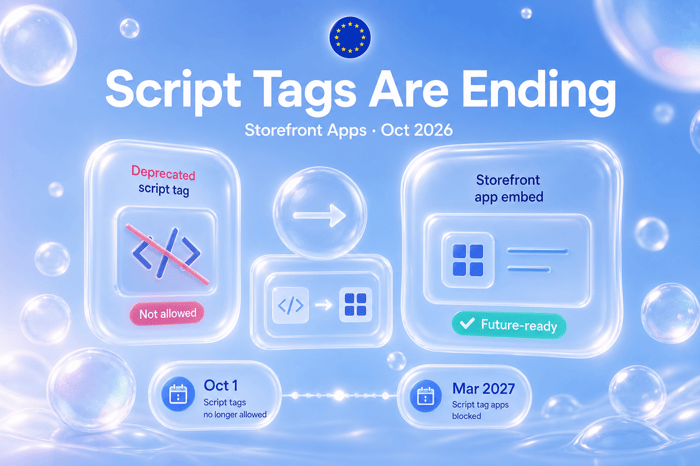
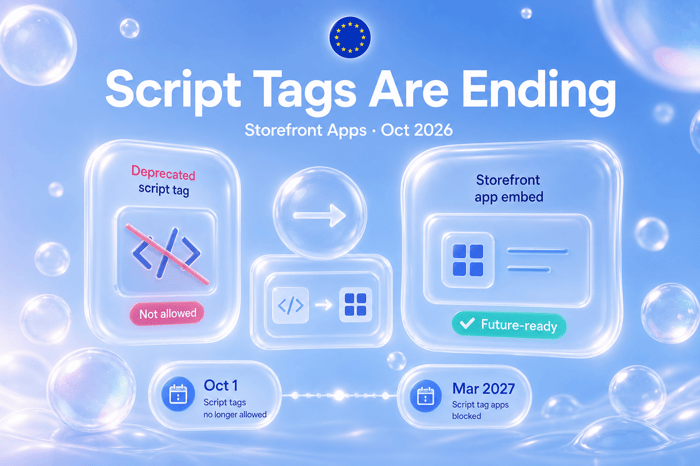
Shopify is retiring Script Tags as the default way third-party apps inject JavaScript on storefronts. Two dates matter: from 1 October 2026, new script tag registrations stop. From 1 March 2027, existing script tags no longer inject on customer-facing pages. If your product badges, reviews widgets, urgency timers, or compliance overlays still depend on script tags, they will disappear unless the app vendor migrates to theme app extensions and app embeds.
This guide is for merchants who do not read Partner API changelogs. It explains what breaks, how to audit apps, and why badge-style apps (including AI disclosure tools) should already use embeds.
Platform migration guidance, not legal advice. Compliance apps still need correct legal configuration after technical migration.
What script tags were
Script tags let apps register a JavaScript URL Shopify loaded on every storefront page. For years, that was the fast path: ship a JS bundle, inject overlays, hijack DOM nodes, done. Downsides accumulated:
Performance hit on Core Web Vitals
Race conditions with themes and other scripts
Security and privacy review gaps
Unpredictable breakage on Online Store 2.0 themes
Shopify’s replacement model: theme app extensions with declarative app embed blocks merchants enable in the theme editor.
Deprecation timeline
| Date | What happens | Merchant action |
|---|---|---|
| 1 Oct 2026 | No new script tag registrations | Reject new apps that only offer script tags |
| 15 Sep 2026 | checkout.liquid grace ends (related platform shift) | Audit checkout extensions separately |
| 1 Mar 2027 | Script tags stop injecting on storefront | Confirm every app uses app embeds or dies |
October 2026 is the early warning. March 2027 is when customer-facing JS from legacy integrations goes dark.
Symptoms your store still uses script tags
App docs say “enable script tag” or auto-install without theme editor step
Overlay appears on storefront but no app block in theme customizer
Badges flicker or load late after page paint
App support asks you to paste code in theme.liquid (different anti-pattern, still fragile)
Developer Tools → Network shows unknown third-party JS from cdn.shopify.com script tag endpoints
Migrate to theme app embeds
Modern Shopify apps ship an app embed toggle:
Online Store → Themes → Customize
App embeds (bottom of left nav)
Enable the app’s embed for your theme
Save; verify on live PDP and collection pages
App blocks (section-level) vs app embeds (global):
App embeds — good for floating widgets, global badges, analytics with consent
App blocks — good for section-specific UI in JSON templates
Compliance overlays on product media typically use app embeds so every PDP gets consistent treatment without per-theme surgery.
Badge apps: reviews, urgency, AI disclosure
Badge categories affected by script tag retirement:
| App type | Script tag risk | Modern pattern |
|---|---|---|
| Review stars on product cards | High (legacy review apps) | App block or embed + metafields |
| Trust / payment badges | Medium | Theme section or embed |
| EU AI Act photo labels | Low if using current apps | Theme app extension (e.g. EU AI Label) |
| Sustainability icons | Medium | Embed; substantiate claims separately (ECGT) |
EU AI Label publishes Article 50 overlays via theme app extension — not script tags. If you use EU AI Label, enable the embed in theme editor per install docs. Legacy generic badge apps may still be on script tags; ping vendor before March 2027.
Merchant audit process
List installed apps touching storefront UI (exclude pure admin apps).
For each, check docs for “theme app extension” or “app embed.”
In theme editor, confirm embed toggles exist and are ON for production theme.
Remove orphaned script tag references from custom theme code if your agency added duplicates.
Staging test: disable script tag manually if vendor provides migration beta; compare DOM.
Coordinate with checkout extensibility migration if same vendor handles both surfaces.
Performance and SEO upside
App embeds load in a controlled order relative to theme assets. Merchants often see fewer layout shifts when badge apps migrate off late-injected script tags. SEO benefit is indirect: faster LCP, less JS failure, fewer hidden overlays that Google renders but users miss.
Link to EU compliance stack
Script tag migration is technical. EU obligations remain: GPSR PDP blocks, PPWR packaging, ECGT green claims, EU AI Act Article 50 labels. A migrated embed that renders nothing because admin classification is empty still fails deployer transparency. See EU compliance checklist.
FAQ
Will script tags work after 1 October 2026?
Existing tags may still inject until 1 March 2027, but no new registrations. Migrate before October to avoid last-minute vendor queues.
Do script tags affect Shopify admin?
This deprecation targets customer-facing storefront pages, not admin UI.
Can I keep one legacy app on script tags until 2027?
Risky. Vendor may not maintain compatibility. Plan replacement Q4 2026.
Is pasting JavaScript in theme.liquid a workaround?
Discouraged by Shopify; breaks on theme updates; worse for performance than app embeds.
Where do partners managing many stores get help?
euailabel.app/partners for agency rollout of AI disclosure embeds alongside other app migrations.
Next steps
Audit app embeds in your live theme before October 2026. Email vendors still on script tags. Treat March 2027 as a hard outage date for any storefront overlay you rely on for compliance or conversion.
Deprecation dates reflect Shopify developer documentation at time of writing. Confirm in Shopify Help Center for updates.