


Table of Contents
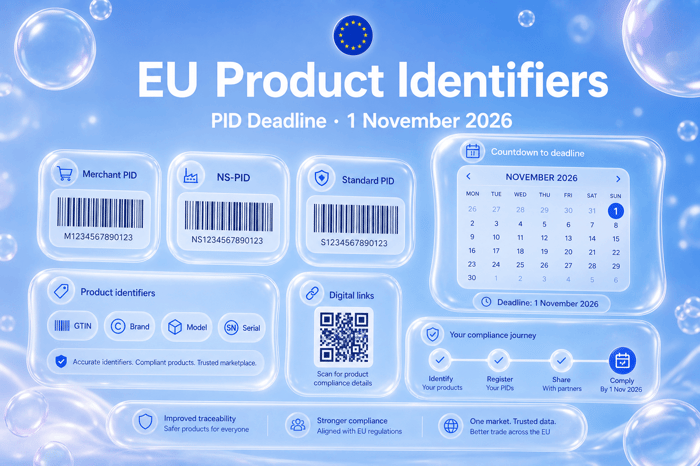
From 1 November 2026, many goods imported into the EU for B2C sale must carry structured Product Identifiers (PID) in customs and safety data flows. PID is part of the EU’s push to link products, economic operators, and surveillance systems — the same direction of travel as GPSR traceability and ICS2 data quality, but with a specific identifier schema and deadlines merchants cannot ignore.
Shopify has no native PID field. If you sell physical SKUs into the EU, you will store identifiers in metafields, ERP, or compliance middleware and pass them to brokers, marketplaces, and Responsible Persons. This guide explains the three identifier types, who must submit them, and a practical catalog prep checklist.
Not legal advice. PID scope depends on product category, import channel, and implementing rules. Confirm with customs and product compliance advisers.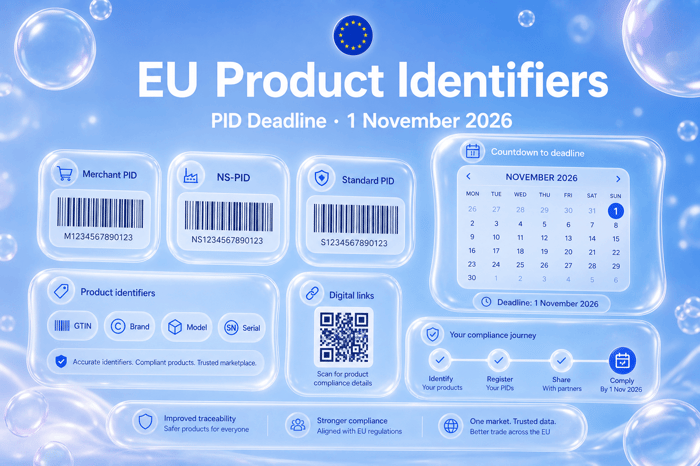
What EU Product Identifiers are
PID assigns standardised ways to identify a product and its operator across EU systems. The framework supports market surveillance, customs risk analysis, and recall traceability. Think of it as moving from “SKU in Shopify admin” to “recognised identifier customs and authorities can match across borders.”
PID work intersects with:
GPSR product traceability and Responsible Person records
ICS2 pre-arrival declaration data (descriptions, HS codes)
Marketplace seller verification programmes requiring product data uploads
The three identifier types
| Identifier | Typical use | Shopify merchant note |
|---|---|---|
| Product ID (product identifier) | Identifies the product model / trade item | Often GTIN (EAN/UPC), or category-specific ID where GTIN not used |
| Operator ID | Identifies manufacturer, importer, or RP | Link to your EU Responsible Person or manufacturer registration |
| Facility / establishment ID | Where relevant for regulated categories | More common in food, cosmetics, medical adjacent; confirm scope |
Not every SKU needs every identifier type. Category-specific EU rules and import scenarios determine mandatory combinations. Generic DTC apparel with valid GTINs faces a different path than cosmetics or electronics with CE marking.
B2C imports and the November 2026 deadline
The 1 November 2026 milestone targets B2C import scenarios where goods enter the EU for direct online sale to consumers. Triggers include:
Consolidated express/postal shipments with inadequate product data historically
Cross-border DTC from UK, US, China, and other non-EU fulfilment nodes
Platforms and carriers acting as data intermediaries to customs
Failure modes mirror ICS2: holds, re-documentation fees, delisting from marketplaces that pre-validate PID fields.
Why Shopify has no native PID field (and what to do)
Shopify product records centre on commerce: title, variant, price, inventory, barcode. PID requires regulatory semantics beyond barcode alone:
Operator linkage (who places on market)
Category-qualified identifier type
Consistency with customs declaration and GPSR file
Recommended pattern:
Metafield namespace — e.g.
eu_compliance.pid_product,eu_compliance.pid_operator,eu_compliance.gtinERP or PIM as source of truth for brands with >500 SKUs; sync to Shopify via API
Shipping / customs middleware mapping metafields to declaration payloads
Launch SOP — no new SKU live without identifier triple-check
Compliance apps may add PID UI layers; verify they export data your broker accepts and that you retain records if you uninstall.
GTIN strategy for DTC brands
Many merchants already have UPC/EAN on variants. PID readiness often starts with:
Unique GTIN per variant (no duplicate reuse across unlike products)
GTIN on physical label matching Shopify barcode field
Operator ID tied to EU Responsible Person GPSR appointment
Private-label brands without GTINs should plan acquisition through GS1 or national issuers before November 2026 — lead times exist.
Pre-November 2026 checklist
Inventory EU-import SKUs by volume; prioritise top 80% revenue
Confirm GTIN or category-specific product ID for each
Document operator ID (manufacturer / importer / RP)
Align with ICS2 customs descriptions and HS codes — identifiers must match declared goods
Test declaration with broker on sample shipment
Update marketplace feeds (Amazon, etc.) if separate from Shopify
Train ops: PID is not marketing’s job alone
Stacking with other 2026 EU rules
PID does not replace PPWR packaging files, ECGT green-claim substantiation, or EU AI Act Article 50 labels on AI product photos. It is one data layer in a stacked compliance model. Merchants using EU AI Label for deployer transparency still need PID for physical goods crossing borders.
Broader timeline: Shopify EU compliance checklist.
FAQ
Is PID the same as a barcode on my Shopify variant?
Barcode/GTIN is often the product identifier component, but PID may also require operator and other IDs depending on category and import path.
Do digital products need PID?
PID targets physical goods in import/surveillance flows. Digital-only SKUs are generally out of scope.
What if I fulfil from EU warehouse?
Import-at-border rules differ from intra-EU stock already cleared. Map your supply chain node by node.
Can my 3PL submit PID for me?
Often yes if data is in their WMS — but you remain commercially responsible for accuracy. Feed them structured metafields, not ad hoc spreadsheets.
Where can I read about AI product photo rules separately?
euailabel.app/faq covers Article 50 deployer disclosure — orthogonal to PID.
Next steps
Assign metafields now, populate GTINs and operator IDs for EU-facing SKUs, and run a broker test before 1 November 2026. PID is catalog hygiene with customs consequences — Shopify will not prompt you; your ops process must.
PID requirements derive from EU product and customs reform packages; implementing acts may refine categories and formats. Confirm with qualified advisers for your import routes and product types.