


Table of Contents
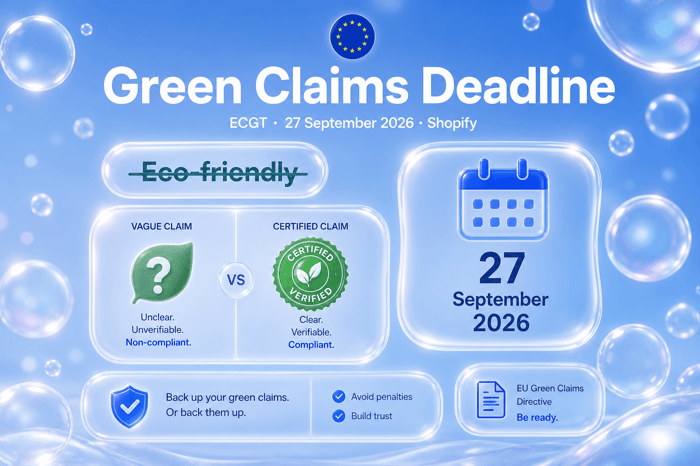
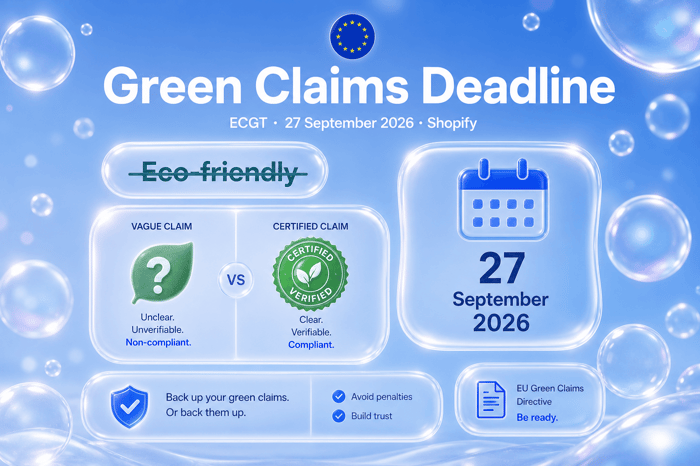
From 27 September 2026, Directive (EU) 2024/825 — part of the Empowering Consumers for the Green Transition (ECGT) package — becomes enforceable across the EU. National authorities can act against traders who mislead consumers with vague environmental claims, unqualified sustainability badges, or marketing that implies a product is greener than it is without substantiation.
If your Shopify product pages say “eco-friendly,” “planet-positive,” or slap a leaf icon next to a SKU without a file drawer of evidence, this deadline matters. ECGT is not PPWR (packaging waste) and not the proposed Green Claims Directive still winding through Brussels. It is live consumer-law reform with teeth in your PDP copy, collection banners, and email campaigns.
Not legal advice. Claim substantiation depends on product, market, and how you phrase benefits. Work with counsel and your sustainability team before publishing revised copy.
What ECGT changes for Shopify merchants
ECGT amends the Unfair Commercial Practices Directive and the Consumer Rights Directive. For DTC brands, the practical shift is:
Generic environmental claims without proof are high risk — broad terms like “sustainable” or “conscious” need clear, verifiable meaning tied to the product.
Unverified sustainability labels are restricted — trust marks and eco-labels must come from established certification schemes, not clipart badges you designed in Canva.
Durability and repair claims face scrutiny — if you market longevity, be ready to show how you tested it.
Early obsolescence and misleading comparisons — implying environmental benefit versus a vague “industry average” without data is exactly what regulators target.
Shopify does not police your adjectives. Consumer authorities and competitor complaints do.
PDP copy audit: where greenwashing hides
Run this audit on your top 20 revenue SKUs first, then collections and homepage hero copy.
| Surface | Common problem | Fix pattern |
|---|---|---|
| Product title / subtitle | “Eco” or “Green” baked into the name | Rename unless claim is substantiated per SKU; move specifics to body copy with evidence |
| Bullet benefits | “100% sustainable materials” | State material, percentage, standard (e.g. GRS-certified recycled polyester, 80%) |
| Collection banners | “Planet-first collection” | Replace with measurable collection-wide criteria or remove |
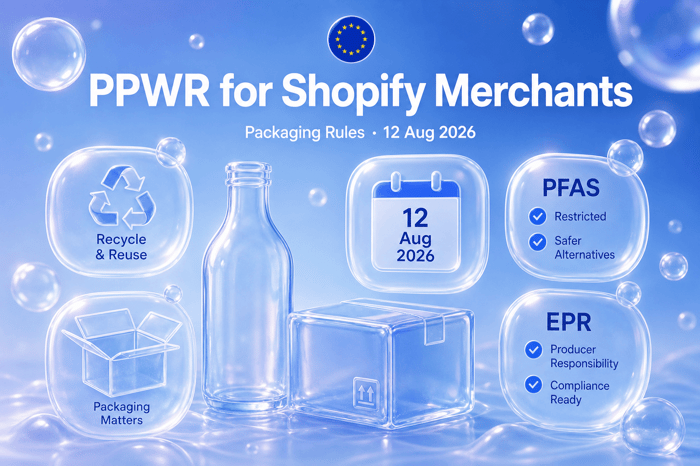
| Packaging callouts | “Plastic-free” while PPWR files show mixed materials | Align with PPWR documentation; see packaging rules from 12 Aug 2026 |
| Image overlays | Leaf badges on product photos | Only if tied to certified scheme; do not confuse with AI disclosure labels |
| Metafields → feeds | Green tags flow to Google Merchant Center | Audit syndicated claims; GMC has its own misrepresentation policies |
Export product descriptions to a spreadsheet. Highlight every environmental adjective. If marketing cannot point to a test report, certificate, or defined lifecycle metric within 24 hours, treat the claim as non-compliant until rewritten.
Vague green terms to rewrite or remove
These words are not banned automatically — but unsupported use is exactly what ECGT targets:
“Eco-friendly” / “environmentally friendly”
“Sustainable” without specifying what aspect (materials, energy, transport, end-of-life)
“Natural” when you mean marketing tone, not a legal product category
“Carbon neutral” without scope, offset methodology, and third-party verification
“Biodegradable” without conditions (industrial compost vs home, timeframe)
“Zero waste” for a SKU that still ships in poly mailers
Replace vague terms with specific, checkable statements: recycled content percentage, certified scheme name, repair programme details, or take-back partner. Shoppers and regulators both prefer numbers over poetry.
Certified labels vs decorative badges
ECGT distinguishes legitimate environmental labelling schemes from self-made icons. Acceptable patterns include:
Labels from EU or widely recognised certification bodies (FSC, GOTS, EU Ecolabel where applicable)
Scheme rules that govern who may use the mark and how
Certificate numbers or licence IDs you can produce on request
Risky patterns:
Custom “earth friendly” stamps with no scheme behind them
Aggregated score badges from unaudited SaaS widgets
Implying EU official endorsement when you only mean “ships to Europe”
If you use Shopify apps that inject sustainability badges on PDPs, verify the app’s data source. A pretty overlay is still your claim.
A merchant workflow before September 2026
Inventory claims — legal, marketing, and ops in one room; list every live environmental statement.
Evidence map — link each claim to certificate, LCA excerpt, supplier letter, or test report.
Rewrite PDPs — specific copy in Shopify admin; version-control major changes.
Train agencies — paid social and influencer briefs must match substantiated PDP language.
Monitor feeds — Google, Meta catalogues, and marketplaces often pull old metafield values.
Separate regimes — PPWR (packaging), GPSR (safety), ECGT (marketing), EU AI Act (AI imagery) stack; one fix does not cover all.
For AI-generated product photos marketed as “real” or heavily retouched lifestyle shots with sustainability themes, remember Article 50 deployer transparency is a different obligation. Green copy does not replace AI disclosure. See Shopify AI Act checklist if that applies to your catalog.
Who enforces and what triggers action
National consumer protection authorities enforce ECGT. Triggers include competitor complaints, authority sweeps of ecommerce sectors, and media investigations. Fines vary by member state. The reputational cost of a greenwashing headline often exceeds the fine.
Document your substantiation before you need it in a letter from a regulator. A shared folder beats scrambling through supplier inboxes under deadline.
FAQ
Is ECGT the same as the Green Claims Directive?
No. Directive (EU) 2024/825 (ECGT) is adopted and applies from 27 September 2026. The proposed Green Claims Directive (explicit environmental claims substantiation) was still in legislative process as of 2026 — watch Brussels, but do not wait to clean up PDPs.
Do green claims rules apply to US-only Shopify stores?
ECGT targets traders making environmental claims directed at EU consumers. If you sell into the EU, assume it applies to that audience regardless of where your company is registered.
Can I still say “recycled packaging”?
Yes, if true and specific — material, percentage, and alignment with your PPWR documentation. Vague “eco packaging” without detail is weaker.
What about carbon offset badges at checkout?
Offset claims need clear methodology and must not imply the product itself has zero impact unless substantiated. Checkout apps that promise “carbon neutral shipping” should be reviewed like PDP copy.
Where can I read more EU compliance topics?
See euailabel.app/faq for AI transparency and cross-links to other 2026 EU obligations for Shopify merchants.
Next steps
Export your catalog copy, flag vague green language, and tie every remaining claim to evidence before 27 September 2026. ECGT rewards specificity. Your Shopify PDP is a marketing asset and a compliance surface — treat it as both.
ECGT references Directive (EU) 2024/825 and related consumer protection law. National implementation details may vary. Confirm with qualified counsel for your markets and product categories.