


Table of Contents
Regulation (EU) 2023/988 — the General Product Safety Regulation (GPSR) — has applied since 13 December 2024. If you sell physical goods to EU consumers from Shopify, you are likely in scope. GPSR is not new in 2026, but many DTC brands still treat it as a B2B paperwork exercise while their product detail pages (PDPs) show neither an EU Responsible Person nor the safety information shoppers and market surveillance authorities expect.
This guide explains GPSR from a merchant deployer perspective: what must appear on the product page, how Shopify metafields and compliance apps help, and where enforcement actually looks.
Not legal advice. GPSR interacts with product-specific CE/UKCA regimes, cosmetics rules, food law, and your role as manufacturer, importer, or distributor. Confirm with counsel for your SKUs.
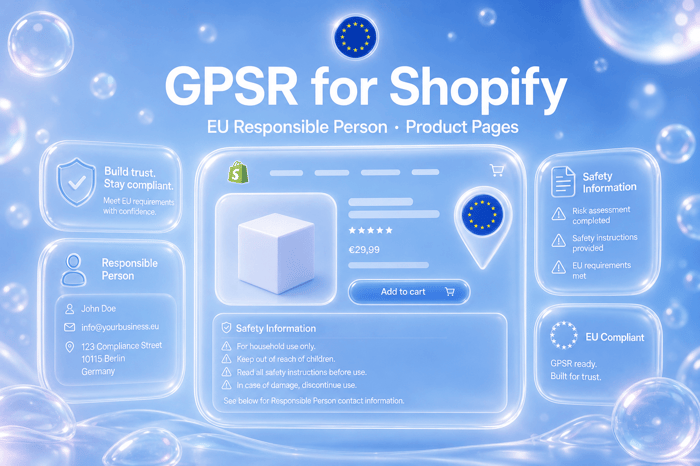
What GPSR requires on the storefront
GPSR modernises EU product safety for non-food consumer products. Core themes:
Safe products placed on the market with appropriate documentation
Traceability — manufacturer identity, contact details, product identification
EU Responsible Person for non-EU manufacturers — a legal entity in the EU who holds documentation and cooperates with authorities
Product information visible to consumers — warnings, instructions, identifiers
Incident reporting and cooperation with recalls
Unlike the EU AI Act (Article 50 for AI imagery) or PPWR (packaging), GPSR is about physical product safety and who authorities call when something goes wrong.
EU Responsible Person: who needs one?
| Scenario | Typical GPSR role | Responsible Person? |
|---|---|---|
| EU-based brand manufacturing in EU | Manufacturer in EU | Often not required; manufacturer details on product |
| US/UK brand importing into EU | Importer or manufacturer via EU entity | Yes — EU-based Responsible Person unless you are established manufacturer in EU |
| Private label, factory in Asia, brand in EU | Manufacturer (EU brand) | Depends on structure; EU brand may be manufacturer |
| FBA / 3PL stock in EU, non-EU brand | Importer of record often critical | Usually yes for non-EU manufacturer |
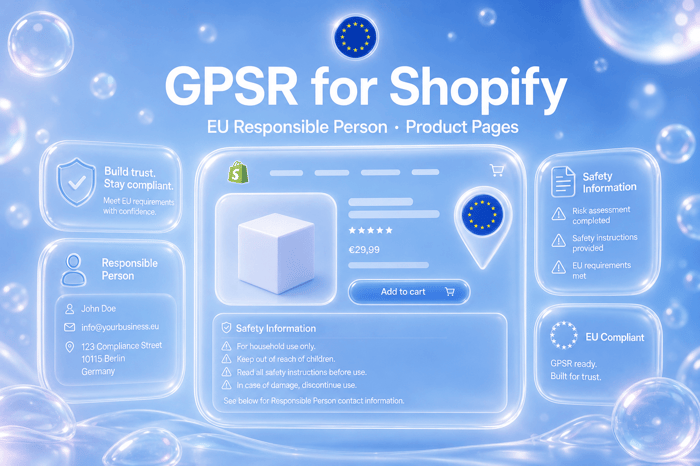
The Responsible Person must be established in the EU, hold the technical file or access it, and respond to authority requests. Many merchants use authorised representative services. Display their name, postal address, and electronic contact on the product or packaging — and on the PDP where online sales happen.
What belongs on Shopify product pages
GPSR expects information consumers need for safe use. For ecommerce, treat the PDP as part of the product label:
Manufacturer name and contact (address, email or URL)
EU Responsible Person name and contact (when required)
Product identifier (type, batch, serial, or SKU system linking to traceability)
Warnings and safety instructions in language of the member state sold to
CE marking where applicable (with proper conformity basis — GPSR does not replace CE product regulations)
Do not bury this only in a PDF linked from the footer. Authorities and plaintiffs read the PDP.
Shopify metafields vs compliance apps
Shopify has no native GPSR module. Merchants typically use:
Product metafields — custom namespace for manufacturer, RP name, address, warnings; rendered via theme section or app block
Compliance apps — inject structured GPSR blocks on PDPs, sometimes sync across markets
Theme edits — hard-coded snippets for single-brand stores
| Approach | Pros | Cons |
|---|---|---|
| Metafields + theme | No app fee; full control | Manual per SKU; easy to drift on new products |
| Compliance app | Faster rollout; templates | Monthly cost; verify data stays yours on uninstall |
| Footer-only legal page | Quick | Insufficient for product-specific warnings and RP per SKU |
Metafields are storage, not compliance. Enforcement cares whether the shopper sees correct safety info for that product, not whether you used a fancy schema.
Enforcement reality in 2026
Market surveillance checks warehouses, marketplaces, and websites. Common failure modes for Shopify merchants:
No EU Responsible Person on record for non-EU manufacturer
Generic “Contact us” instead of RP postal address
English-only warnings sold into Germany, France, or Poland
Drop-shipped goods with no technical file accessible in EU
Marketplace listings missing GPSR block while DTC site is compliant
Amazon and other channels have tightened GPSR seller requirements. Align Shopify PDPs with marketplace backends — inconsistent data invites delisting.
Practical workflow for Shopify ops
Classify SKUs — which products need CE, cosmetics notification, food exceptions, etc.
Appoint Responsible Person if you are non-EU manufacturer selling into EU.
Build technical files per product category; RP must access them.
Metafield template — manufacturer, RP, warnings, identifier; mandatory on product create SOP.
Theme render — visible block above fold or in accordion that search engines and shoppers index.
QA new launches — no SKU goes live without GPSR block review.
Stack other 2026 rules — PPWR packaging, ECGT green claims, ICS2 customs data; see EU compliance checklist.
GPSR vs AI transparency and marketing rules
GPSR blocks belong near safety warnings — not confused with sustainability badges (ECGT) or AI-generated photo labels (EU AI Act Article 50). A product page might need all three layers: safety/RP text, substantiated green claims, and visible AI disclosure on images. Different laws, different app categories.
FAQ
Did GPSR replace the old General Product Safety Directive?
Yes. GPSR (Regulation 2023/988) replaced the GPSD framework and has applied since 13 December 2024.
Can I put GPSR info only in the package insert?
Physical labelling matters, but online sales require information on the sales channel. Relying only on insert for ecommerce is weak practice.
Does Shopify Markets handle GPSR translations?
Markets help localise storefronts; you still supply correct metafield content per language. Auto-translate warnings without legal review is risky.
Is the EU Responsible Person the same as an authorised CE representative?
Related concepts under different regulations. Your RP provider may cover multiple roles — verify scope in contract.
Where do AI product photo labels fit?
Separate regime under Article 50. If you use AI imagery, see FAQ and pricing for EU AI Label — it does not replace GPSR text blocks.
Next steps
Audit top SKUs for missing Responsible Person and safety fields on PDPs. Standardise metafields, render them in theme, and block launches without GPSR data. GPSR has been live since late 2024 — treating it as optional is the riskiest posture in 2026.
GPSR references Regulation (EU) 2023/988. Product-specific regulations may impose additional marking and conformity requirements. Confirm with qualified counsel.
SEO PAGE TITLE: META DESCRIPTION: PRIMARY KEYWORD: SECONDARY KEYWORDS:, , , URL SLUG: