

EU AI Label vs LabelAI: Discovery Engine or Deployer Workflow?
 Damian Klimarczyk
English | EU AI Act (Article 50) | EU AI Label App vs Compliance Apps
Damian Klimarczyk
English | EU AI Act (Article 50) | EU AI Label App vs Compliance Apps
11 minute read
Table of Contents
- The fork: two theories of Article 50 tooling
- What Article 50 asks deployers
- LabelAI: strengths and blind spots
- EU AI Label: strengths and blind spots
- Side-by-side deployer workflow comparison
- The metadata mirage
- Pricing logic: unlimited labels vs counted labels
- Can you combine them?
- Decision matrix
- Fair acknowledgment
- FAQ
- Get started
Summer 2026 produced two Shopify apps for the same deadline — 2 August 2026, when Article 50 deployer transparency rules bite for many AI product photos sold to EU shoppers. LabelAI (by BEK Service GmbH) and EU AI Label both overlay badges on product images without editing theme code. That surface similarity hides a deeper split under the EU AI Act: one app tries to find AI images for you; the other assumes you already know what you published and builds a disclosure workflow around that.
This is not a “which app is best” scorecard. It is a deployer decision guide: what Article 50 actually asks merchants to do, where auto-scanning helps, where it misleads, and which tool fits your catalog economics.
Not legal advice. Confirm obligations with counsel for your store.
The fork: two theories of Article 50 tooling
| School | Representative app | Starting question |
|---|---|---|
| Discovery-first | LabelAI | “Which images in my shop might be AI-generated?” |
| Declaration-first | EU AI Label | “Which product photos did I knowingly generate or materially alter with AI?” |
Both end with a visible storefront badge. The workflow before the badge is completely different — and that workflow is where compliance risk actually lives.
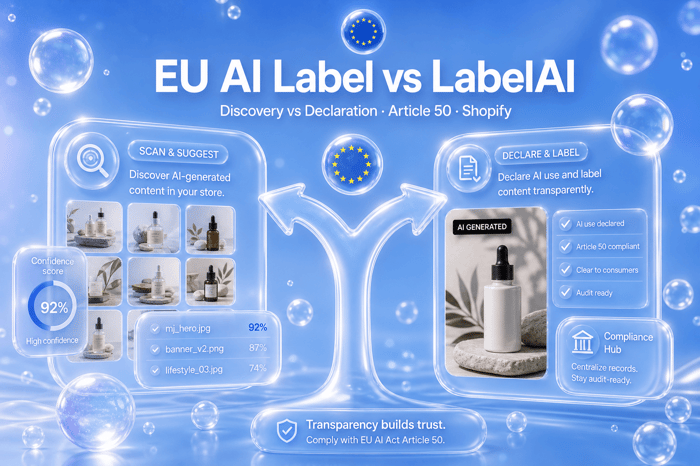
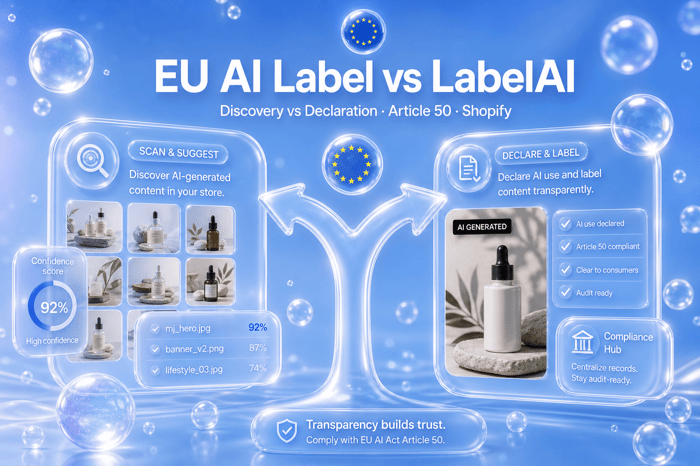
LabelAI scans product and file images for signals of AI generation: content-credential metadata, known AI-tool filename patterns, and alt-text hints. You review suggestions, see a confidence indicator and reasons, confirm or reject, and enable a theme embed so labeled images show a badge across the storefront.
EU AI Label does not position scanning as the compliance center. Merchants classify photos as AI-generated or AI-modified (individually or in bulk), pick Code of Practice–aligned presets, publish overlays via a theme app extension, export classification history to CSV, and optionally publish a public Compliance Hub at /pages/ai-transparency.
Neither approach replaces legal counsel. Both can support transparency workflows under the EU AI Act. The question is which failure mode you are trying to avoid.
What Article 50 asks deployers
Under Regulation (EU) 2024/1689 Article 50(4)/(5), deployers (merchants publishing under their brand) must disclose AI-generated or artificially manipulated content in a clear, distinguishable, accessible way at first exposure. For product photos, that means a human-readable label on the image — not a policy page alone, not hover-only disclosure, not metadata shoppers never see.
Machine-readable provenance (C2PA, IPTC) is mainly a provider conversation (Article 50(2)). Shopify’s upload and CDN pipeline often re-encodes and strips embedded metadata. A scanner that reads file metadata is useful for inventory and audit — but metadata survival is not the deployer test shoppers face on the product page.
LabelAI: strengths and blind spots
What LabelAI does well
LabelAI’s pitch is genuinely differentiated on the App Store today:
-
Unlimited AI image scanning even on the free plan — good for “what did we forget?” audits across product images and the file library.
-
Auto-suggestions with reasons and a confidence indicator — faster than manually opening every SKU.
-
Bulk confirm all suggestions on Pro — operational speed when scan quality is high.
-
Unlimited labeled images on Pro ($9.99/mo or $99/yr) — flat economics for catalogs where most photos are AI.
-
Five storefront languages listed on the App Store: English, German, French, Spanish, Italian.
-
No theme code — theme editor embed, same overlay class as competitors.
For a merchant who inherited a messy media library, lost track of which creatives came from Midjourney, or onboarded hundreds of SKUs from an agency without provenance notes, discovery-first tooling has real value.
Where the discovery model strains
-
Filename patterns and alt-text are not evidence.
midjourney_v4_hero.jpgis a hint, not proof. Alt text is merchant-written and can be wrong or empty. Auto-labeling from weak signals risks false positives — disclosing images that were not AI-generated. -
Metadata scanning hits Shopify reality. If C2PA/IPTC survived upload, scanning is smart. If the CDN stripped it — common on Shopify — the scanner under-reports while the deployer duty still applies to images you know you made with AI.
-
“AI-generated” vs “AI-modified” matters. Article 50 and the EU Code of Practice distinguish generated content from materially manipulated photos. LabelAI’s public messaging centers AI-generated disclosure. Merchants using AI background swaps, synthetic models, or heavy generative retouch on real photography need a clear modified path — not only a “generated” badge.
-
Scan success ≠ disclosure quality. An app can find images and still ship icon-only badges, low-contrast pills, or disclosures that fail Code of Practice user-testing guidance (text-first labels perform better than icon-only).
-
No public Compliance Hub listed — discovery and badge, not a canonical deployer transparency URL for regulators or journalists.
LabelAI is a strong audit and triage story. Treating the confidence score as a legal safe harbor is the mistake.
EU AI Label: strengths and blind spots
What EU AI Label does well
EU AI Label bets on merchant declaration + enforced disclosure quality:
-
AI-generated and AI-modified presets aligned with Code of Practice language (
AI + GENERATED/AI + MODIFIEDtemplates). -
CoP guardrails — text-first labels, contrast checks, no icon-only primary disclosure, default top-right placement clear of sale badges.
-
Localized storefront badges and accessible tooltips — disclosure understandable in the shopper’s language (English, German, French on App Store; broader EU locales on the product roadmap).
-
Bulk classification in admin — tag many photos without a scanner, when you know your pipeline.
-
CSV classification history — deployer audit trail with export.
-
Compliance Hub — toggle publishes
/pages/ai-transparencynaming the merchant as deployer, explaining labeling approach, linking to the labeling log. -
WordPress / WooCommerce companion plugin — same workflow off Shopify.
-
EU AI Icon — burned-in labels for email, ads, and marketplaces where overlays do not travel.
-
Partners program for agencies running multiple stores.
Overlay rendering does not modify catalog files — uninstall removes badges. Original assets stay as uploaded.
Where the declaration model strains
-
No shop-wide AI scanner — if you genuinely do not know which legacy images are AI, EU AI Label does not auto-discover them from metadata or filenames. You classify what you know; audit gaps remain your process problem.
-
Per active labeled photo pricing — economical when only part of the catalog is AI (Free: 10, Starter $7: 100, Growth $15: 500, Pro $29: 2,000, Scale $49: 10,000). A store labeling every product photo may pay more than LabelAI’s unlimited Pro tier.
-
Merchant discipline required — declaration-first only works if ops actually tags new AI shots on ingest. No scanner nudging you about forgotten files.
EU AI Label is a publication and governance story. It does not pretend filename heuristics replace merchant knowledge.
Side-by-side deployer workflow comparison
| Dimension | LabelAI | EU AI Label |
|---|---|---|
| Core philosophy | Find likely AI images, confirm, badge | Merchant declares AI photos, badge with guardrails |
| AI auto-scan | Yes — metadata, filenames, alt-text | Not positioned as compliance center |
| Confidence / reasons UI | Yes | No (merchant-driven classification) |
| AI-generated label | Yes | Yes |
| AI-modified / altered label | Not emphasized in listing | Yes — distinct preset |
| Bulk workflow | Bulk confirm suggestions (Pro) | Bulk select + classify in admin |
| Storefront rendering | Theme embed overlay | Theme app extension overlay |
| Edits image files | No | No |
| Localized shopper text | 5 languages listed | EN/DE/FR + expanding EU locales |
| Accessible tooltips | Not highlighted on listing | Yes — hover/tap detail layer |
| WCAG / contrast guardrails | Not listed | Yes — CoP-driven validation |
| Audit export | Not listed | CSV classification history |
| Public transparency page | Not listed | Compliance Hub /pages/ai-transparency |
| WordPress / WooCommerce | Shopify only | Companion plugin |
| Off-store burned-in labels | Not listed | euaiicon.com |
| Agency / multi-store | Not listed | Partners program |
| Free tier | 10 labels + unlimited scan | 10 active labeled photos |
| Paid headline | $9.99/mo unlimited labels | Scales by labeled photo count ($7–$49/mo) |
Verify live App Store pricing before purchase — both apps were new in 2026 with zero reviews at time of writing.
The metadata mirage
LabelAI’s scan stack is intellectually honest about where AI might hide: credentials in files, tool fingerprints in names, hints in alt text. That is legitimate forensics.
The deployer obligation under the EU AI Act is different: what does the shopper see on the product page at first exposure?
| Signal | Good for | Weak for |
|---|---|---|
| C2PA / content credentials in file | Audit, provider workflows | Storefront disclosure if stripped on CDN |
Filename patterns (dalle, mj_, etc.) |
Triage | Proof — trivial to rename |
| Alt text | Workflow reminders | Evidence — merchant-controlled |
| Visible text badge on live PDP | Article 50(4)/(5) deployer test | Nothing — this is the center |
A merchant who runs LabelAI, confirms every suggestion, and publishes readable badges has a workflow. A merchant who runs LabelAI, trusts confidence scores blindly, and ships tiny icon-only badges has activity, not necessarily disclosure.
Pricing logic: unlimited labels vs counted labels
LabelAI Pro wins on simplicity: one price, unlimited labeled images, unlimited scan. If you are an AI-native brand where most catalog photos are synthetic and you want flat billing, the math is obvious.
EU AI Label wins when AI is a subset of a large catalog — 2,000 SKUs, 40 AI hero shots. You pay for active labeled photos, not total images. A 500-SKU consumables brand refreshing 30 AI seasonal shots pays Growth-tier pricing, not “label everything” economics.
| Catalog shape | Likely cheaper fit |
|---|---|
| AI-heavy catalog (majority of photos synthetic) | LabelAI Pro unlimited |
| Mixed catalog (AI subset, many real photos) | EU AI Label tiered |
| Agency, 12 client stores | EU AI Label partners + per-store counts |
| “I need to find forgotten AI first” | LabelAI scan (any tier) |
Can you combine them?
Practically, yes — and saying so is more honest than pretending one app solves every layer:
-
LabelAI scan → triage file library and surface forgotten AI assets.
-
Merchant review → confirm generated vs modified vs false positive with human judgment.
-
EU AI Label → publish CoP-guardrailed overlays, Compliance Hub, CSV audit, EU locales.
-
EU AI Icon → burn labels into email and social files that leave Shopify.
That is two subscriptions. Many merchants will pick one. The combined path is for teams that want discovery + governance without treating scan output as legal conclusion.
Decision matrix
| You are… | Start with |
|---|---|
| Inherited messy media library, unsure what is AI | LabelAI scan → manual review |
| Know your AI pipeline, need publish workflow + audit | EU AI Label |
| Heavy AI-modified photography (not full generation) | EU AI Label (modified preset + guardrails) |
| Labeling hundreds of AI photos, flat budget | LabelAI Pro unlimited |
| Labeling dozens of AI photos in a large catalog | EU AI Label counted tiers |
| WooCommerce or WordPress catalog | EU AI Label plugin |
Need public /pages/ai-transparency deployer page |
EU AI Label Compliance Hub |
| Email / Instagram assets need burned-in labels | EU AI Icon (either stack) |
| Agency running multiple Shopify stores | EU AI Label partners |
Fair acknowledgment
LabelAI shipped a real idea the market needed: most merchants do not have perfect provenance hygiene. Scanning filenames and surviving metadata beats pretending every store owner remembers which ZIP came from Firefly. BEK Service GmbH’s marketing background shows in a product that leads with operational discovery — not legal theater.
EU AI Label’s bet is that disclosure quality and deployer governance outlive the scan — generated vs modified language, text-first CoP alignment, accessibility, audit surfaces, and commerce-specific surfaces (Compliance Hub, WooCommerce, off-store burn-in). Different job, overlapping storefront outcome.
FAQ
Is LabelAI “better” because it scans?
Not automatically. Scanning helps find candidates. Article 50 still requires clear visible disclosure on images you publish. Scanning without review creates false labels; scanning without readable badges creates invisible compliance theater.
Is EU AI Label “better” because it has a Compliance Hub?
The Hub is governance — useful for deployer transparency storytelling, not a substitute for on-image labels. EU AI Label does both. LabelAI focuses on find-and-badge; choose based on whether you need the Hub and CSV audit workflow.
Do I need both AI-generated and AI-modified labels?
If your pipeline includes both full synthetic renders and heavy AI alteration of real photos, your workflow should distinguish them. Code of Practice guidance treats generated vs manipulated as distinct disclosure contexts. Confirm borderline retouch cases with counsel.
Does either app make me legally compliant?
No Shopify app guarantees compliance. Both support transparency workflows under the EU AI Act. Counsel still decides scope for your products and markets.
What about IPTC and C2PA?
Useful for provenance and provider tooling. Not a deployer substitute for visible labels on the product page. See euailabel.app/faq.
Where is the Shopify checklist?
euailabel.app/shopify-ai-act-checklist
Get started
Run a declaration-first Article 50 workflow on Shopify with EU AI Label — or audit your library with LabelAI first if discovery is the gap. Burn a free one-off labeled asset at euaiicon.com. More deployer myths: FAQ.
EU AI Label supports transparency workflows under Regulation (EU) 2024/1689 Article 50. It is not legal advice and does not guarantee compliance. LabelAI is a separate product by BEK Service GmbH; features and pricing reflect public App Store listings at time of writing.