


Table of Contents
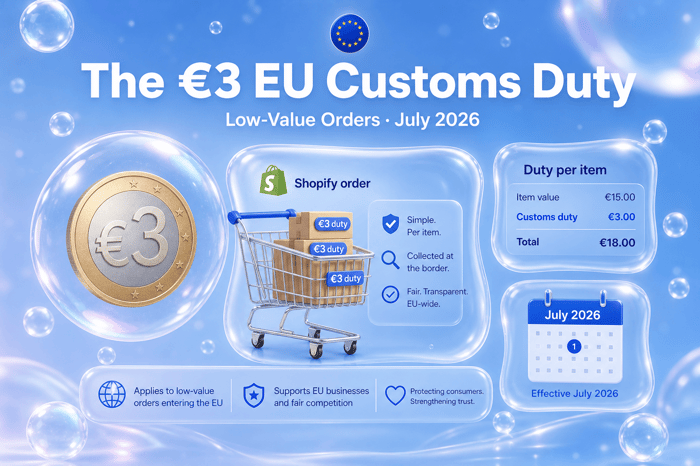
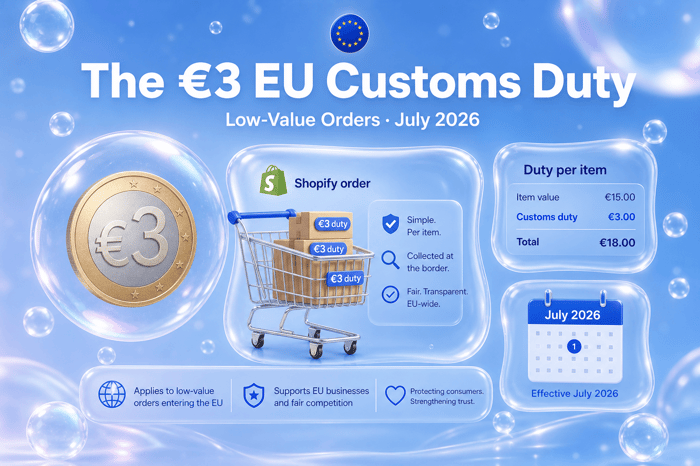
From 1 July 2026 through approximately July 2028, the EU applies a flat €3 eu customs duty per item on many low-value B2C imports that previously cleared with minimal or zero duty under the old de minimis treatment. For Shopify DTC brands shipping single units or small baskets from the US, UK, or Asia into the EU, checkout totals, IOSS strategy, and customer surprise fees changed overnight.
This article explains the mechanics merchants feel in Shopify admin, carts with multiple line items, and IOSS eligibility. It is operational guidance, not tax or legal advice.
Not tax advice. Customs duty, VAT, and IOSS treatment depend on product classification, ship-from location, consignment value, and member state practice. Confirm with your tax adviser and customs broker.
What changed when de minimis ended
For years, many low-value parcels entered the EU with simplified customs treatment. Reforms targeting e-commerce imports removed the practical “de minimis” duty exemption for B2C consignments in scope of the new rules. The transitional flat €3 per item duty is a policy compromise: easier to administer than full ad valorem duty on every €12 phone case, but materially more expensive for multi-item orders.
Key merchant-facing effects:
Per-item stacking — three units in one order can attract €9 duty before VAT
Carrier collection — buyers may pay duty + handling on delivery if not prepaid
IOSS boundaries — IOSS still covers VAT on consignments up to €150, but duty is a separate line in the new regime
Conversion impact — EU shoppers compare landed cost; sticker shock at doorstep hurts repeat rate
Per-item duty math on Shopify carts
| Cart example | Items | Flat duty (illustrative) | Merchant note |
|---|---|---|---|
| Single t-shirt | 1 | €3 | Duty may exceed product margin on ultra-low AOV |
| Bundle: 3 socks (3 line items) | 3 | €9 | Quantity drives duty harder than order value |
| Buy 2 get 1 free (3 units shipped) | 3 | €9 | Promo structure affects landed cost |
| Order >€150 consignment | Varies | May fall outside flat scheme | Full customs valuation rules may apply |
Shopify Markets and tax apps handle VAT presentation; duty at checkout is less standardized. Many merchants absorb duty, pass through via DDP shipping products, or accept DAP and field support tickets.
IOSS and the duty line
Import One-Stop Shop (IOSS) lets registered sellers collect and remit VAT on distance sales of imported goods up to €150. IOSS did not eliminate customs formalities. Under the 2026 rules:
VAT may still be collected via IOSS at checkout
The €3 duty per item may need separate calculation, remittance, or DDP handling depending on setup
IOSS registration remains valuable for VAT compliance; it is not a universal “all-in import fee”
Work with a EU VAT agent or broker to model: absorb vs pass-through, DDP carrier contracts, and invoice wording.
Shopify operational responses
1. Landed-cost pricing tests
Raise EU prices or bundle shipping + duty into a regional price list via Shopify Markets. A/B test conversion vs margin.
2. Delivered Duty Paid (DDP) shipping
Carriers offering DDP calculate duty and bill the merchant. Cleaner buyer experience; requires accurate HS codes and descriptions (see ICS2 stop-words guide).
3. EU fulfilment node
Stock in EU warehouse shifts economics from import duty to local VAT and logistics cost. Break-even depends on volume.
4. Checkout transparency
Plain language: “Import duties included” or “Duties may apply on delivery” — match reality to reduce chargebacks.
5. Support scripts
CS teams need a duty FAQ aligned with your incoterms. Confusion between VAT, duty, and carrier handling fees is routine.
Timeline: July 2026 to July 2028
The flat €3 per item mechanism is described as transitional through roughly July 2028, when broader customs reform may replace it with fully harmonised e-commerce import rules. Merchants should not treat “temporary” as “optional” — two years of orders at wrong economics kills unit economics.
Parallel deadlines in 2026:
ICS2 stop-words — 3 August 2026
PPWR packaging — 12 August 2026
EU Product Identifiers — 1 November 2026
Customs data quality affects duty calculation accuracy. Fix catalog upstream.
What this guide deliberately does not do
We do not tell you whether IOSS registration fits your entity structure, which incoterms your carrier contract uses, or how to classify ambiguous SKUs. Those require professional advice. We map what Shopify merchants feel in P&L and CX when €3 per item stacks.
FAQ
Does the €3 duty apply to every Shopify order into the EU?
Many B2C low-value imports in scope of the transitional rules yes; exclusions and higher-value consignments may use different treatment. Confirm with your broker.
Can Shopify calculate €3 duty automatically at checkout?
Native checkout duty support varies by Markets setup and apps. Many merchants use shipping apps, DDP services, or regional pricing instead.
If I use IOSS, do I skip duty?
No. IOSS is primarily a VAT collection mechanism. Duty may still apply separately under 2026 rules.
Does UK-to-EU shipping follow the same rule?
Post-Brexit UK exports to EU are third-country imports. Similar duty themes apply; verify current UK-EU customs practice.
Where is the broader EU compliance picture?
Shopify EU compliance checklist and FAQ cover GPSR, AI Act, and other topics.
Next steps
Model duty stacking on your top EU cart shapes, decide absorb vs DDP vs regional pricing, and align customs descriptions before ICS2 tightens in August. The €3 line item is a product and finance decision — not something Shopify silently fixes.
Customs duty rules reference EU e-commerce import reform and transitional flat-rate provisions described for July 2026–2028. Rates, scope, and implementation may change. Consult qualified tax and customs professionals.