

PPWR for Shopify Merchants After August 2026: What to Fix Now
English | Français
7 minute read
Table of Contents
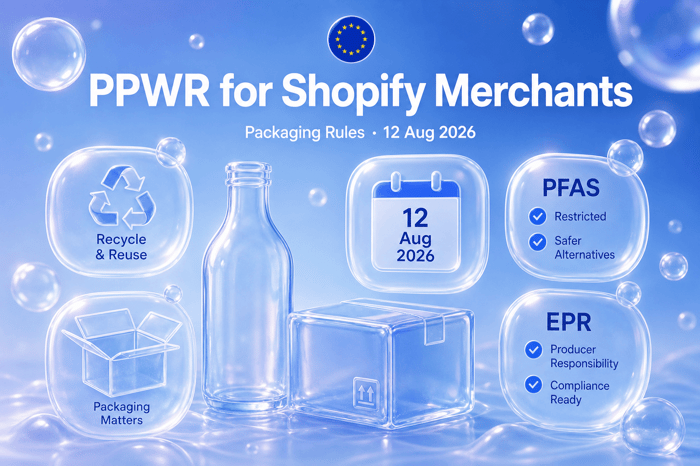
Regulation (EU) 2025/40 on packaging and packaging waste — the PPWR — has been law since February 2025. For most packaged goods placed on the EU market, the operational start date is 12 August 2026. If you run a Shopify DTC brand shipping physical products into the EU, PPWR is not a distant packaging-policy debate. It is a supply-chain and documentation regime that can block sales, trigger recalls, or expose you to national enforcement if your boxes, pouches, mailers, or food-contact materials do not meet the new rules.
This guide is written for merchants and ops leads, not packaging engineers. It explains what PPWR changes after August 2026, who counts as a manufacturer when you private-label or import, and a practical checklist you can run before your next production run.
Not legal advice. PPWR interacts with national EPR schemes, product-specific rules, and your contract structure. Confirm obligations with counsel and your packaging suppliers.
What PPWR changes for ecommerce
PPWR replaces much of the old Packaging Directive and pushes the EU toward circular packaging: less waste, higher recycling, extended producer responsibility (EPR), and tighter substance limits. Unlike a storefront cookie banner, PPWR lives upstream — in your BOM, your supplier contracts, and your conformity files.
For Shopify merchants, the pain points usually appear in three places:
-
What you ship in — mailers, void fill, inner bags, bottles, caps, labels on packaging.
-
Who is legally responsible — brand owner, importer, or fulfilment partner placing packaged goods on the EU market.
-
What you must register and report — EPR in member states where you sell, plus technical documentation for packaging formats.
PPWR does not replace GPSR product safety, green-claims marketing rules, or the EU AI Act. It stacks alongside them. If you are building a 2026 compliance calendar, see our broader timeline in the Shopify EU compliance checklist.
Key PPWR obligations from 12 August 2026
| Topic | What it means for merchants | First hard date |
|---|---|---|
| PFAS in food-contact packaging | Limits on targeted PFAS and total fluorine in packaging that touches food | 12 Aug 2026 |
| Heavy metals in packaging | Combined limit for lead, cadmium, mercury, hexavalent chromium (100 mg/kg) | 12 Aug 2026 |
| Technical documentation & DoC | Conformity assessment and Declaration of Conformity for packaging formats you place on the market | 12 Aug 2026 |
| EPR registration & reporting | Producers and importers must join national packaging EPR schemes and report volumes | Varies by member state; many align with PPWR application |
Further PPWR milestones roll out through 2028–2030: harmonised sorting labels, reusable-packaging marks, minimum recycled content in plastic packaging, and design-for-recycling criteria. August 2026 is the floor, not the ceiling.
Who is the “manufacturer” on Shopify?
PPWR uses EU product-law roles. The manufacturer is whoever places packaging on the market under their name or trademark — or who has packaging designed or manufactured for them and puts it on the market. That often means:
-
Private-label DTC brands importing finished goods in branded packaging — you are likely the manufacturer or importer of record, even if a contract factory prints the box.
-
Merchants using 3PL in the EU — fulfilment location does not automatically shift PPWR duties. Trace who first places packaged goods on the EU market.
-
Drop-shippers — if your brand is on the label and you direct sales to EU consumers, you cannot assume the upstream factory’s compliance covers your obligations.
Document the chain: packaging supplier, material certificates, who holds the DoC, and which entity registers for EPR in each country where you ship.
Operational checklist before August 2026
1. Audit packaging SKUs
List every packaging component that crosses the EU border: outer shipper, product box, inner wrap, inserts, tape, labels. For food, supplements, cosmetics, and beverages, flag anything with direct food contact first — PFAS rules bite there earliest.
2. Request PFAS and heavy-metal declarations
Ask suppliers for test reports or material declarations against PPWR substance limits. Generic “FDA compliant” statements are not PPWR proof. If a supplier cannot substantiate, treat it as a production stop until you have data.
3. Build technical files and DoC
For packaging formats you place on the market, maintain technical documentation showing conformity with applicable PPWR requirements. A Declaration of Conformity signed by the responsible party should be available for market surveillance authorities. Store copies with your quality or compliance folder — not only on a supplier’s shared drive.
4. Register for EPR where you sell
EPR is national. If you ship to Germany, France, Spain, and Italy, you likely need registrations (or a compliance scheme) in each. Many merchants use packaging-compliance partners; others register directly with national PROs. Map volumes by material type — your 3PL or carton supplier may have weights, but you own the reporting obligation.
5. Align Shopify ops with physical reality
Shopify does not manage PPWR for you. Use metafields or your PIM to track packaging version, supplier lot, and DoC reference per SKU if you run frequent packaging changes. When you swap mailers for a “eco” alternative, trigger a compliance review — new material, new file.
6. Do not overclaim on the storefront
PPWR is about packaging substance and waste. Green marketing claims on PDP copy are a separate regime under Directive (EU) 2024/825, enforceable from 27 September 2026. Saying “plastic-free packaging” without evidence creates marketing risk even if your PPWR files are clean.
What Shopify does and does not cover
Shopify admin handles catalog, checkout, and fulfilment integrations — not packaging conformity. You will not find a native PPWR module next to taxes or markets. Compliance lives in:
-
Supplier contracts and material specs
-
External EPR registrations
-
Internal SKU documentation (metafields, ERP, or QMS)
If you use multiple sales channels, keep packaging documentation channel-agnostic. Amazon, wholesale, and DTC often share the same physical box.
Enforcement reality
Market surveillance authorities inspect packaging in warehouses, at borders, and through consumer complaints. PFAS in food-contact materials has attracted early media attention. EPR non-registration triggers fines in several member states. Treat PPWR like GPSR: invisible until an audit, painful when it is not.
FAQ
Does PPWR apply to my Shopify store if I am US-based?
If you place packaged goods on the EU market — typically by shipping to EU consumers or holding stock in the EU — PPWR likely applies to your packaging, regardless of where your Shopify admin is registered.
Is my fulfilment centre the manufacturer?
Not automatically. The manufacturer is usually the entity placing packaging on the market under its name or who has packaging made for it. Map roles in writing with your 3PL and suppliers.
Do digital-only products need PPWR compliance?
PPWR targets packaging. Pure digital goods without physical shipment are outside packaging-waste scope, though other EU rules may still apply.
Where does PPWR fit with GPSR and green claims?
GPSR covers product safety and responsible-person details on PDPs. Green-claims rules cover environmental marketing. PPWR covers packaging materials and waste. All three can apply to the same SKU.
Can I use the same compliance checklist for AI product photos?
Different law. For Article 50 AI transparency on product images, see euailabel.app/faq and install guidance for EU AI Label.
Next steps
Start with a packaging SKU audit and supplier declarations before 12 August 2026. Register EPR in your top EU markets. File DoC and test reports where you are manufacturer or importer of record. PPWR is supply-chain work — but your Shopify brand is what authorities will name on the box.
PPWR references Regulation (EU) 2025/40. Requirements evolve through implementing acts and national transposition. Confirm with qualified counsel and packaging experts for your product categories.
Related Articles
EU AI Label vs Uhlenbusch Icons: Overlay or Burn-In?
8 minute read