


Table of Contents
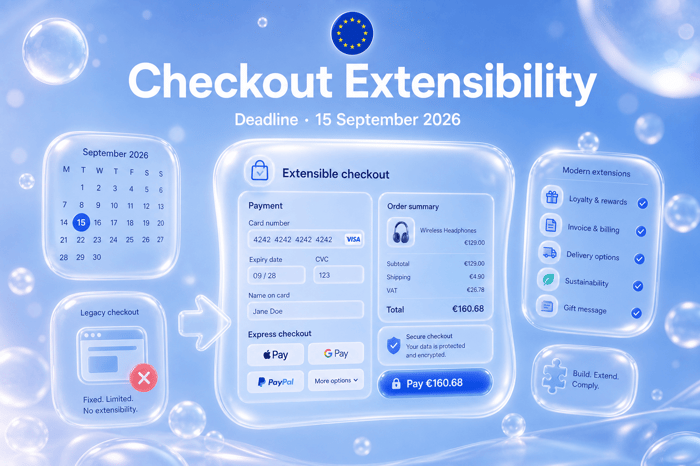
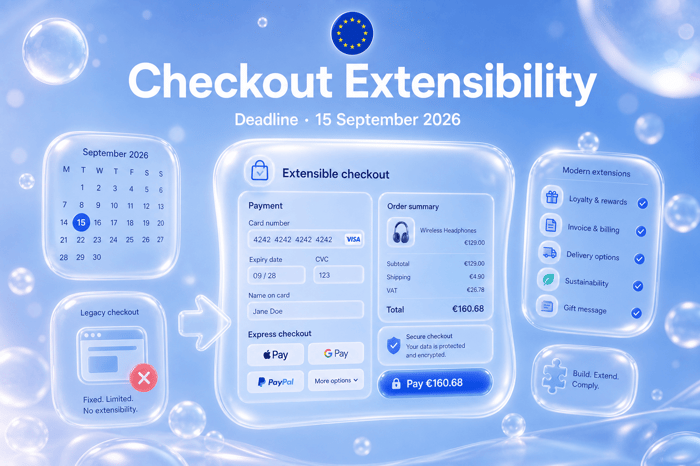
Shopify’s migration from legacy checkout.liquid to Checkout Extensibility reaches a hard milestone on 15 September 2026: the grace period for stores still relying on deprecated checkout customisation ends. After that date, merchants on supported plans must run checkout UI extensions, Shopify Functions, and partner apps built for the new model — not ad hoc Liquid injected into a file Shopify no longer guarantees.
If you run upsells, custom fields, trust badges, EU compliance widgets, or payment logic at checkout, this deadline is an engineering and vendor audit, not a marketing footnote. Missing it breaks checkout apps silently or blocks Shopify admin upgrades.
This guide covers Shopify platform migration, not EU law. Pair checkout work with EU compliance apps (withdrawal, VAT, disclosures) as separate requirements.
What Shopify ended and why
Legacy checkout allowed deep theme-level customization via checkout.liquid on Shopify Plus. That flexibility came at a cost: security, upgrade velocity, and inconsistent buyer experience. Checkout Extensibility replaces direct Liquid edits with:
Checkout UI extensions — sandboxed blocks merchants place in checkout editor
Shopify Functions — server-side logic for discounts, delivery, payment customization
Web pixels / Customer Privacy API — tracking with consent alignment
Theme app extensions — storefront-side siblings to checkout blocks (product pages, cart)
Shopify published phased deprecation timelines; 15 September 2026 is the line in the sand for merchants still on legacy checkout customization paths.
Who is affected
| Store profile | Risk level | Typical action |
|---|---|---|
| Plus with custom checkout.liquid | Critical | Rebuild on UI extensions + Functions; retire Liquid |
| Plus with checkout apps (pre-2023) | High | Verify each app is “Checkout Extensions Ready” |
| Standard plans using checkout apps | Medium | Most apps already migrated; confirm in admin |
| Storefront-only customizations | Lower at checkout | Still audit script tags and theme app embeds separately |
EU DTC merchants often stack checkout apps: upsells, gift messages, terms checkboxes, carbon offsets, B2B PO fields. Each vendor must be extension-native.
How to audit checkout apps
Shopify admin → Settings → Checkout — open checkout editor; note installed blocks and their sources.
Apps list — filter apps touching checkout; open partner docs for “Checkout Extensibility” or “UI extensions.”
Checkout Extensions Ready badge on App Store listings — required signal for compliant apps.
Custom agency code — ask your dev agency if any checkout.liquid snippets remain in git history or private apps.
Staging test — complete test order with every checkout block active; compare pre/post migration.
Apps without migration path: replace before September, not after first failed upgrade ticket.
Theme app extensions vs checkout extensions
Merchants confuse storefront and checkout surfaces. Both matter for EU compliance stacks:
Theme app extensions render on product pages, cart, and collection templates — where GPSR blocks, AI photo labels, and sustainability badges live.
Checkout UI extensions render during payment — where terms acceptance, marketing opt-in, or fee disclosures appear.
Example: EU AI Label uses a theme app extension for Article 50 badges on product imagery — not checkout.liquid. Withdrawal or cookie tools may use checkout or footer surfaces depending on vendor. Map each compliance requirement to the correct extension type.
Shopify Functions you may need to rebuild
Legacy checkout scripts often hid business logic in Liquid or external apps. Functions replace some patterns:
Cart validation (restricted products, EU market rules)
Custom discounts incompatible with native rules
Delivery customization (hide express to certain postcodes)
Payment method ordering or hiding
Functions require developer deployment via app or custom app. Budget time; they are not click-to-install like some legacy scripts.
EU merchant angle: compliance at checkout
Checkout is where EU consumers expect:
Clear pricing including VAT where shown
Terms, withdrawal information links, and pre-contract info
Marketing consent aligned with GDPR
Rebuilding checkout is a chance to re-place compliance widgets correctly in the extension editor — not as hacked HTML in deprecated Liquid. Coordinate with privacy and consumer-law counsel on placement; platform migration does not replace legal content.
September 2026 in your platform calendar
15 September 2026 checkout deadline sits near:
27 September 2026 — ECGT green claims enforcement
1 October 2026 — script tag creation ban (storefront)
1 March 2027 — script tag injection ends
Run one platform compliance sprint: checkout extensions, storefront app embeds, script tag retirement. See our script tags deprecation guide.
Migration checklist
Inventory all checkout.liquid and legacy checkout app dependencies
Confirm Checkout Extensions Ready status per app
Rebuild custom logic as Functions or replace with supported apps
Test EU market checkout flows (Markets, languages, payment methods)
Document new checkout editor layout for CS and marketing
Schedule cutover before 15 September 2026 with rollback plan
FAQ
Does every Shopify store use checkout.liquid?
Historically Plus-only for deep customization. Standard plans had limited checkout editability. If you never customized checkout, impact may be app-vendor-only — still verify.
What happens if I miss the deadline?
Shopify may block checkout customization upgrades, break legacy integrations, or force migration paths. Treat as production outage risk.
Are theme app extensions enough for checkout compliance?
No. Storefront extensions do not replace checkout UI extensions for payment-step widgets.
Do EU AI Label badges need checkout migration?
EU AI Label renders on product images via theme app extension. Checkout migration is unrelated unless you had custom Liquid trying to show AI notices at payment — uncommon.
Where is Shopify EU regulatory checklist?
euailabel.app/shopify-ai-act-checklist covers AI Act, withdrawal, PPWR, and related topics beyond checkout platform changes.
Next steps
Export your checkout app inventory today. Ping vendors without Checkout Extensions Ready status. Retire checkout.liquid before 15 September 2026 and align storefront compliance apps on theme app extensions in the same sprint.
Shopify deprecation dates reflect public Shopify developer documentation at time of writing. Confirm current timelines in Shopify Help and Partner Dashboard for your plan.