


Table of Contents
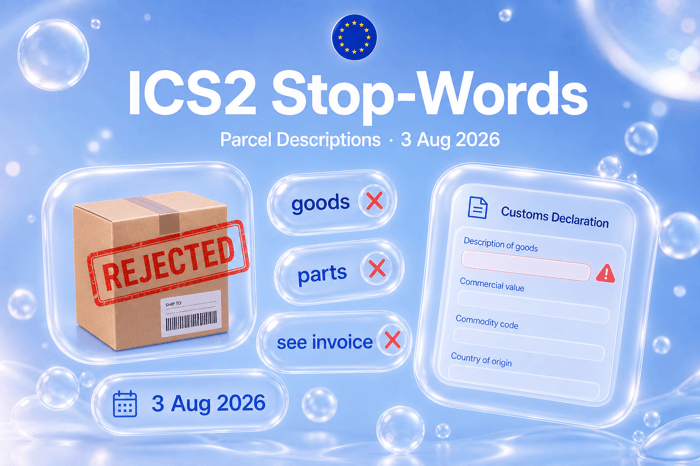
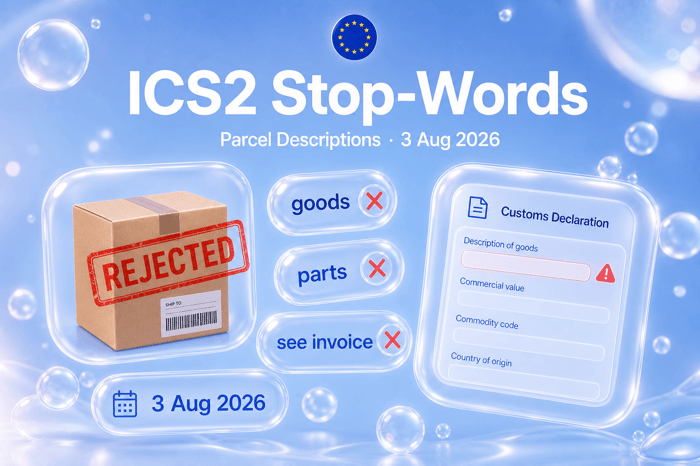
From 3 August 2026, EU customs systems under ICS2 Release 3 tighten data quality on pre-arrival declarations. Carriers and customs brokers increasingly reject parcel lines described with vague terms — “gift,” “sample,” “merchandise,” “parts,” or product titles copied verbatim from Shopify with no material or function detail. For DTC brands, the failure mode is familiar: orders stuck in clearance, returns to sender, angry customers, and fulfilment teams manually re-keying data under time pressure.
ICS2 is not a Shopify setting. It is an EU import safety and security programme. But the fix starts in your catalog — HS codes, customs descriptions, and how fulfilment apps pass data to DHL, UPS, FedEx, or postal consolidators.
Not legal advice. Customs classification and valuation are specialist domains. Work with your broker and tax adviser for binding tariff decisions.
What ICS2 Release 3 changes
Import Control System 2 (ICS2) requires economic operators to submit Entry Summary Declaration (ENS) data before goods arrive in the EU. Release 3 extends requirements to postal and express consignments in certain bands, with emphasis on:
Accurate goods descriptions — what the item is, not marketing language
Consistent HS / tariff codes aligned with description
Stop-word rejection — generic placeholders flagged as insufficient
Party data quality — seller, buyer, routing; less merchant-visible but still critical
Stop-words are not a secret list published for meme culture. Customs and carriers publish guidance: descriptions must identify the goods plainly (e.g. “women’s cotton t-shirt” not “apparel” or “SKU-4421”).
Where Shopify merchants break ICS2 data quality
| Upstream source | Bad pattern | Why customs rejects it |
|---|---|---|
| Product title only | “CloudFlex Runner — Midnight” | Brand name without material/category |
| Generic line item | “Merchandise” / “Goods” | Classic stop-word territory |
| Marketing adjectives | “Premium wellness product” | No countable noun customs can classify |
| Missing HS code | Blank harmonized code in shipping app | Broker must guess; delays or holds |
| Mixed cart | One line “Order #10422” | Multi-SKU orders need line-level detail |
| Bundle SKUs | Single code for kit of unlike items | May need decomposition for customs |
Shopify checkout collects what the customer pays. Customs wants what physically crosses the border. Those are related but not identical datasets.
Fix the catalog upstream
1. Add a dedicated customs description field
Use product metafields (e.g. customs.description) separate from SEO title. Template: [gender if relevant] + material + product type + key attribute. Example: “Men’s stainless steel wristwatch, quartz movement, 42mm.”
2. Assign HS codes per SKU
Harmonized System codes at 6–10 digit level depending on destination. Do not copy a competitor’s code from a forum. Use broker-assisted classification for your BOM, especially kits, electronics, cosmetics, and supplements.
3. Country of origin
ICS2 and duty rules need origin, not only ship-from warehouse location. Align with commercial invoice and supplier declarations.
4. Map metafields to carrier APIs
Review Shopify Shipping, ShipStation, Easyship, Sendcloud, or 3PL middleware. Confirm which field populates customs description on the label. Many integrations default to product title — override explicitly.
5. Decompose bundles in fulfilment logic
If you sell starter kits, either pre-define component lines for customs or use a fulfilment rule that expands bundles to constituent SKUs with codes.
Common stop-words and weak terms to avoid
Treat these as red flags in automated validation (carriers publish evolving lists; validate against your broker’s current guidance):
gift, present, sample, promotional
merchandise, goods, items, products
parts, accessories (without saying parts of what)
document, paperwork (unless true)
see invoice, as described, miscellaneous
pure SKU or internal code strings
Build a pre-shipment lint step: if description matches stop-word regex or is under N characters without a material noun, block label generation.
August 2026 in context
ICS2 stop-word enforcement from 3 August 2026 sits beside other August deadlines: EU AI Act Article 50 (2 August), PPWR packaging (12 August). Customs delays do not care about your marketing calendar. A parcel held at Frankfurt because the description said “supplement” instead of “food supplement capsules, 60 count, herbal blend” is pure ops pain.
If you sell into the EU with the new €3 per item customs duty regime from July 2026, accurate line data also affects duty calculation and IOSS eligibility. See our guide on Shopify and the €3 customs duty — classification errors compound cost.
Merchant workflow checklist
Export top 100 SKUs by EU volume.
Audit current carrier submission for each (pull sample labels / broker files).
Write customs descriptions; assign HS codes with broker sign-off.
Configure metafields → shipping app mapping.
Train 3PL: no generic descriptions on manual orders.
Monitor rejection reports weekly through August 2026 ramp-up.
FAQ
Does ICS2 apply to IOSS parcels under €150?
Data quality requirements still apply in many channels; IOSS simplifies VAT collection, not description quality. Confirm with your carrier for your service level.
Can I use the same description for US and EU customs?
Often similar, but EU ICS2 validation may be stricter on stop-words. Maintain EU-specific descriptions if needed.
Who is liable for bad descriptions?
Typically the declarant (carrier, broker, or you depending on incoterms and setup). Commercially, the brand pays in delays and chargebacks.
Does Shopify automate HS codes?
Not natively at scale. Use metafields, ERP, or shipping apps with classification support.
Where does this fit in overall EU compliance?
See Shopify EU compliance checklist and FAQ for GPSR, PPWR, and AI transparency topics.
Next steps
Before 3 August 2026, stop shipping EU orders with generic customs lines. Fix descriptions and HS codes in Shopify catalog data, wire them into fulfilment, and validate with your broker on a live test shipment. Clearance speed is a conversion metric.
ICS2 rules evolve under EU customs law. Carrier implementations differ. Confirm current stop-word lists and filing obligations with your logistics and customs advisers.